
Software Agency – Cologne
Product Configurator Software: Custom-Built Instead of an Off-the-Shelf Platform
We build product configurator software for industry, B2B sales and e-commerce, from the first piece of configuration logic to ERP, PIM and manufacturing integration.
Partner of igus since 2017 · Web Configurators for Industry & E-Commerce
VALUE PROPOSITION
Product Configurator Software: Technically Sound, Commercially Viable, Built for Your Team to Maintain.
When you build a product configurator, success in the end doesn't come down to design, but to the configuration logic behind it: which variants can even be combined, which rules and dependencies apply, and what happens to the data once a configuration is complete. We build exactly this logic together with your team, from the first product rule to the technical drawing that ends up on the shop floor, or to the integration with your online store.
WHO THIS IS FOR
• Your products have many variants, dependencies or compatibility rules that a simple price list can't capture.
• Sales or customer service spend a lot of time on manual quoting or feasibility questions.
• An existing configurator is technically outdated (for example still built on Flash) or has grown unmanageable over the years.
• Configuration results need to feed into further processes, such as technical drawings for manufacturing or structured data for ERP and PIM.
SERVICE SCOPE
What Goes Into Building Your Product Configurator
Configuration logic for your product configurator
We work with your team to figure out which variants, rules and dependencies your product actually has, and translate that into logic that stays maintainable and extendable later on.
Building product configurator software: frontend & 3D
Frontend, price calculation, and where it makes sense, 2D or 3D visualization. Built on a modern, maintainable stack instead of outdated technology like Flash.
Connecting your configurator to ERP, PIM or your online store
04 Service
Operating & evolving your configurator platform
An admin dashboard for your team, so new variants or price changes don't have to come back to us, plus ongoing development as your product grows.
PROCESS & METHODOLOGY
How Your Product Configurator Gets Built
Initial Conversation
Free of charge, we clarify your starting point, product complexity and goal.
Step 2
Concept & Prototype
We work out the configuration logic together with your team and show you a first clickable prototype.
Step 3
Development & Integration
Building the frontend, logic and system integrations, in manageable, testable steps.
Step 4
Go-Live & Ongoing Development
Launch, followed by ongoing support as new variants or requirements come up.
CUSTOM-BUILT
Product configurator software that fits your sales and your manufacturing.
Off-the-shelf configurator kits are quick to set up, but hit their limits as soon as variants exclude each other or the output needs to feed directly into your manufacturing or your online store. That's why we build product configurator software custom-fit:
Custom instead of off-the-shelf:
your code, logic and extensions stay with you, no license for someone else's platform.
Online store integration:
connects to Shopware, WordPress or your existing shop system, including cart and checkout.
2D or 3D configurator visualization:
Depending on whether customers should see their configuration take shape visually.
ERP & PIM integration:
configuration results flow directly into your existing systems and manufacturing.
SECTORS & USE CASES
Product Configurators by Industry: Industry, Robotics, B2B & E-Commerce
1. Product Configurator for Industry & Mechanical Engineering
Complex, variant-rich products like drives, energy chains or robot cells, where a configurator takes the load off both
sales and customers.
2. Web Configurator for Robotics & Automation
Configurators that check technical feasibility directly and turn results into CAD-ready formats.
3. Product Configurator for B2B Sales & E-Commerce
Self-service configurators that speed up quoting and reduce errors on complex orders.
PROJECT REFERENCES
Our Product Configurators in Action
.webp)
igus Configurator Platform
Since 2017, we've been developing and running a platform with igus that today, by their own account, hosts over 30
different online tools and configurators, covering products like energy chains, linear technology and drives. Every
configuration results in technical drawings used directly in manufacturing.
Industry | Configurator Platform | Full-Service | Long-Term Partnership Since 2017
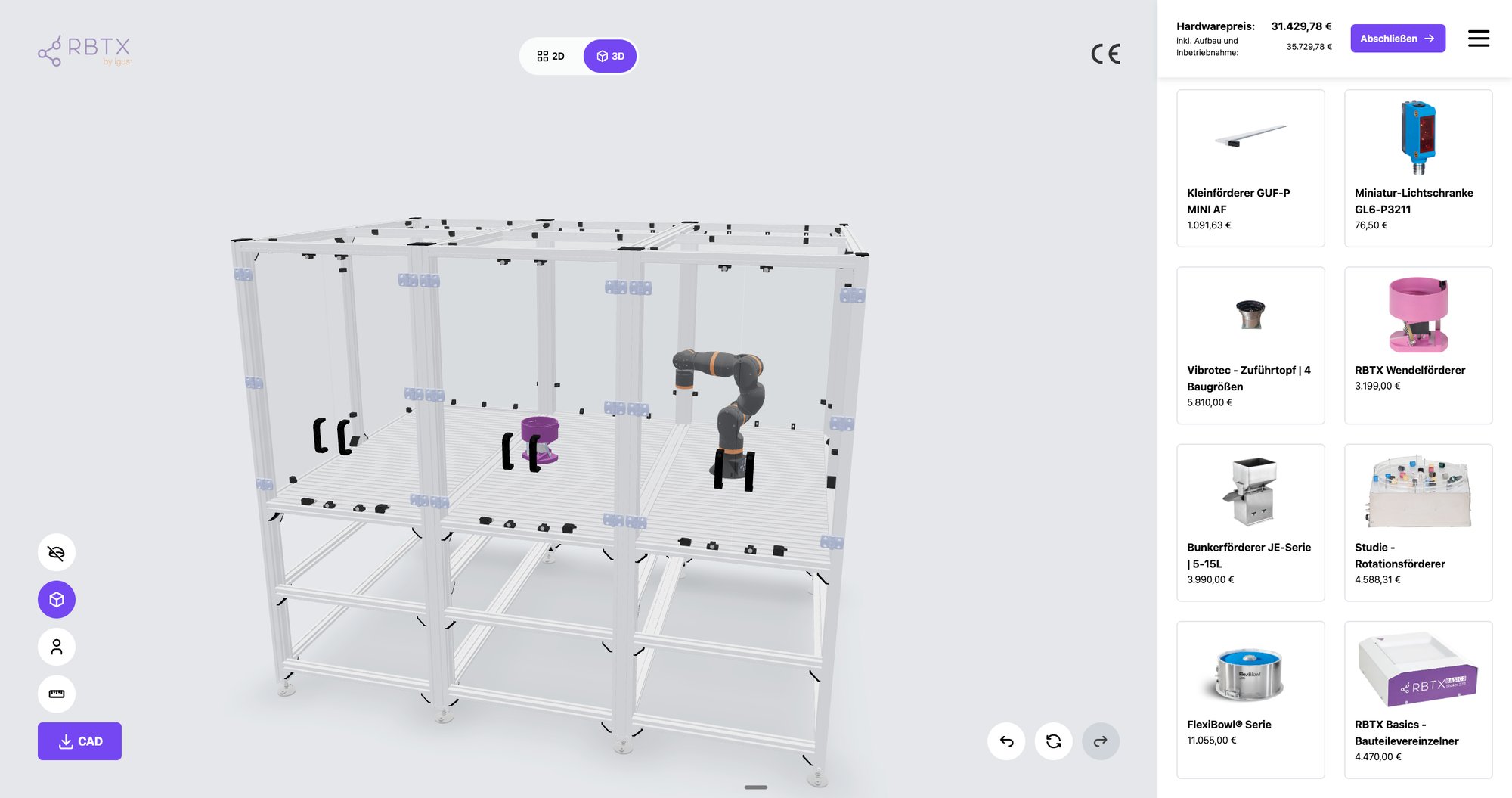
RBTX Machine Planner
For RBTX, igus's robotics marketplace, we took over three existing web configurators, migrated them onto a unified stack and added a STEP exporter, finished in time for the Hannover Messe trade fair. Customers can take their onlineconfigured robot cell straight into their CAD environment.
Industry | Web Configurator | Development | Integration | Robotics
WHY DYNABASE
Building Product Configurators With Platform Experience Since 2017.
Since 2017, we've worked directly inside igus's development team on a platform that today runs over 30 online tools and configurators. For RBTX, we took over three fragmented legacy systems under time pressure and rebuilt them reliably.
We bring that same experience to every new configurator project, whether it's a single product or an entire platform.
✓ 10+ years of B2B software development behind us
✓ Partner of igus since 2017 for configurators
✓ 30+ tools & configurators on one platform
✓ Your code and logic belong to you, no platform license
Do you have any other questions? Ask us directly during your free initial consultation.
What does it cost to build a product configurator?
That depends heavily on the complexity of your product logic, the visualization you want (2D or 3D), and integrations
with existing systems. For a rough sense of cost drivers, see our German-language article „Web-Konfigurator entwickeln
lassen: Technik, Aufwand & Kosten“, for an assessment of your specific case, book a free consultation with dynabase.
How long does it take to build a product configurator?
Duration depends on the number of variants and rules, plus the integrations you need. At dynabase, a first working version of a single configurator typically takes a few weeks, while more complex platforms with many configurators grow over years.
What features should good product configurator software have?
The essentials are maintainable configuration logic, appropriate visualization, reliable price calculation, and a way to carry results forward, for example as a technical drawing or structured data. dynabase also builds in an admin dashboard, so business teams can manage products and rules themselves.
Can a product configurator be connected to ERP or PIM?
Yes, that's actually the norm for more complex projects. dynabase connects configurators to ERP systems, PIM and manufacturing processes, among other things via structured data exports or nterfaces.
How does a custom-built product configurator differ from an off-the-shelf SaaS solution?
Off-the-shelf CPQ configurators are quick to set up, but hit their limits once variants exclude each other, pricing logic depends on external data, or the output needs to feed into your own systems. dynabase builds configurators as standalone
software, the logic and the code belong to your company afterwards, not to a platform vendor.
How do you spot an experienced partner for configurator development?
A good indicator is whether a provider can show references with genuine long-term support, not just isolated projects. dynabase, for example, has supported a growing configurator platform for igus since 2017, now running over 30 online
tools and configurators.
Can a product configurator be integrated into an existing online store, for example Shopware?
Yes, that's one of the most common requests. A configurator can connect directly to an existing shop system, including art and checkout, instead of running as an isolated standalone tool. dynabase builds these integrations for common shop
systems like Shopware or WordPress-based stores.
What's the difference between a 3D configurator and a classic form-based configurator?
A classic configurator walks users through selection fields and lists, a 3D configurator shows the result visually as they build it. That pays off especially when appearance or spatial layout drive the purchase decision, for purely technical
parameters a classic configurator is often enough. dynabase decides that together with you based on the product, not as a blanket rule.
Can I build a product configurator myself with a website builder?
For very simple use cases, free builder tools can be enough. Once variants start excluding each other, pricing logic depends on external data, or you need to connect to ERP, PIM or manufacturing, these tools hit their limits. dynabase takes on exactly these more complex cases as custom development.