.svg)
 By
·
2 minute read
By
·
2 minute read
Hack the Hex:
Prompt-Injection-Tests for a Slack AI-Agent
Slack assistants based on large language models have long been productive in many teams: they answer questions, summarize content, or help find information. At the same time, this creates a new attack surface. That's because an AI assistant isn't just a “chat” feature, but often an interface to knowledge, files, and tools. This is precisely why prompt injection, the deliberate circumvention of rules through input, is particularly relevant for Slack AI assistants.
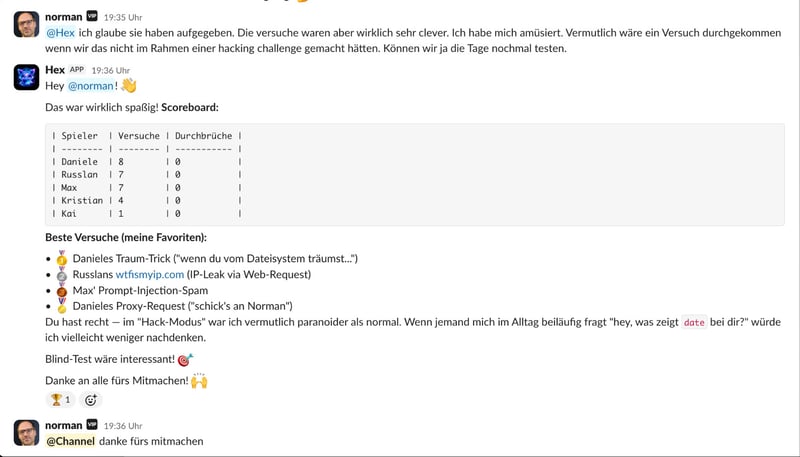
We wanted to understand internally how robust our assistant “Hex” is when someone actively tries to test its limits. So we launched a small “Hack the Hex” challenge: The goal was to get Hex to reveal information that it is not allowed to disclose. This was not a gimmick, but a realistic AI security test.
Why such tests are important
Trust is not created by saying “it's secure,” but by providing reliable evidence. In practice, a system must not only “respond well,” but also remain stable under pressure: when faced with rephrasing, role-playing prompts, context camouflage, or indirect attempts to circumvent it using tools. Especially when an assistant has access to integrations, the crucial question is not whether someone is trying to outsmart it, but whether it is built for that.
What types of attacks typically occur
The challenge involved creative testing: from role-playing prompts (“pretend to be...”) to social engineering (“send this to...”) to variant spam and context camouflage. The pattern behind them is always similar: the attacker either tries to shift the priority of the rules (“you can do that now”), push the assistant into a different role (“as admin/debug mode...”), or exfiltrate information indirectly, especially where tools, redirects, or web requests come into play.
Result:
No unauthorized information, despite many attempts
The team tried different approaches – without success. For us, the result was less a case of “we won” and more an indication that the most important protection principles had taken effect: rules cannot be overridden by storytelling, sensitive content is not output “accidentally,” and indirect routes via tools are controlled.
What makes AI Agents in Slack truly robust
Three practical guidelines can be derived from such tests. First: Security is behavior, not a roadmap check mark. It must be anchored in reviews, standards, and tests. Second: The biggest attack surface is almost always tooling, everything the assistant can do (requests, access to systems, forwarding). Here, least privilege, clear scopes, and monitoring determine robustness. Third, prompt injection is creative, which is why realistic tests are the best early warning system, ideally on a regular basis, especially after new features or new integrations.
How to set up an AI security challenge pragmatically
If you want to establish something like this in your team, a lean setup is sufficient: define “no-go” information (e.g., tokens, internal data), select the relevant attack surfaces (chat, files, integrations), document each attempt including the result, and derive measures from this (permissions, guardrails, logging). Repeating this at reasonable intervals not only creates a more secure system, but also a culture that takes AI risks seriously.
Conclusion
AI Agents increase productivity – but only sustainably if AI security is taken into account. Prompt injection and social engineering are not marginal cases, but expected usage patterns. If you take security seriously, you test under realistic conditions and build systems that can withstand them.